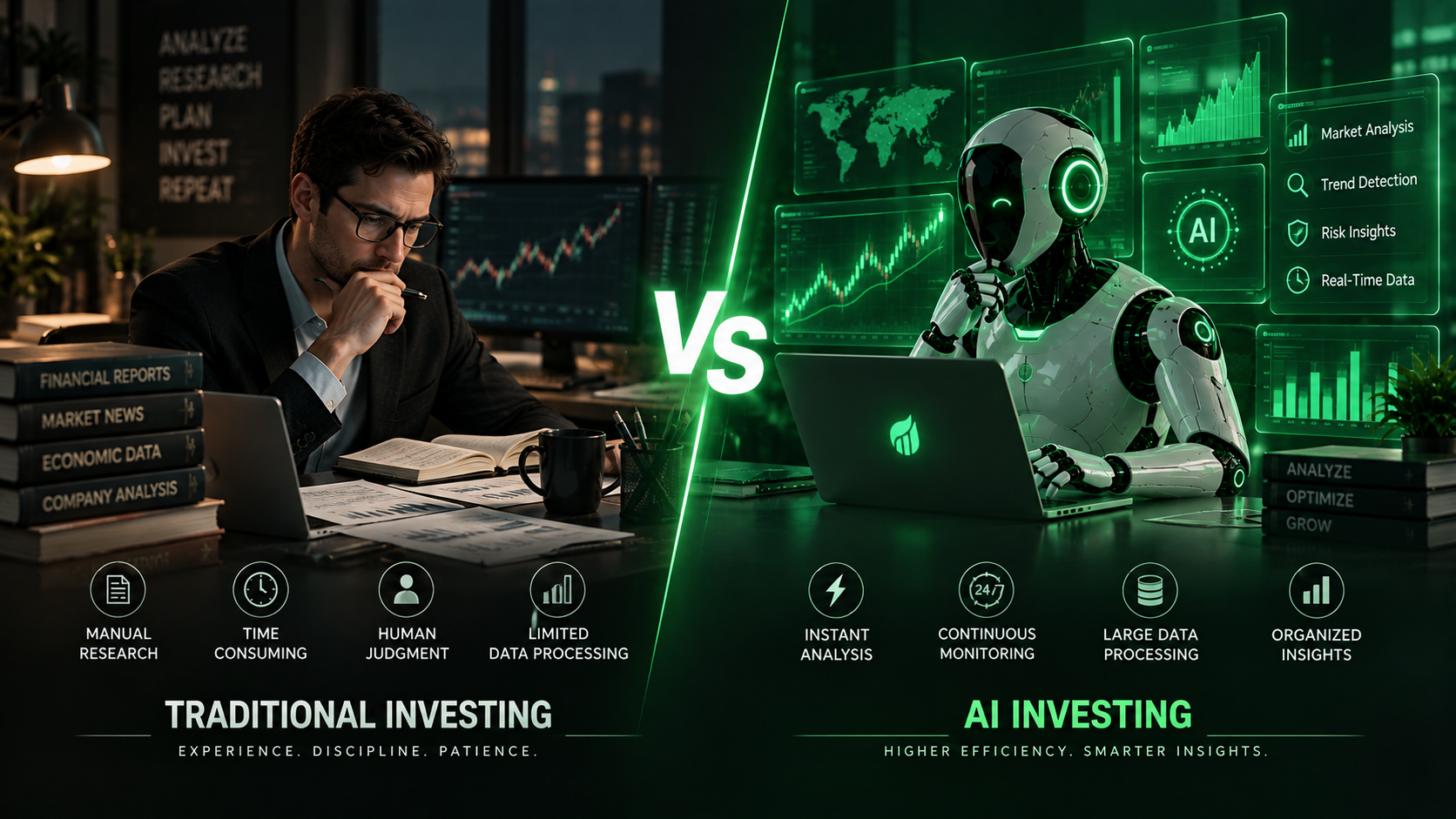
AI Investing vs Traditional Investing
Investing has evolved dramatically over the past decade. While traditional investment strategies continue to play an important role, artificial intelligence has introduced a new way to analyze markets, organize financial information and support investment decisions. Understanding the differences between AI investing and traditional investing can help investors choose the approach that best fits their goals.
Rather than replacing traditional investment methods, artificial intelligence enhances research by processing vast amounts of financial information more efficiently. Many investors now combine both approaches to build a more informed investment strategy.
What Is Traditional Investing?
Traditional investing relies on human research, experience and judgment. Investors analyze company financial statements, review economic reports, study market trends and evaluate technical indicators before making investment decisions.
Professional investors often spend hours each day reviewing financial news, earnings reports, analyst opinions and macroeconomic developments. While this approach remains effective, it can also require considerable time and expertise.
What Is AI Investing?
AI investing uses artificial intelligence to process large amounts of market data automatically. Modern AI systems evaluate financial information, identify trends and organize complex data into structured insights that investors can review more efficiently.
Artificial intelligence does not replace investor judgment. Instead, it acts as a powerful analytical assistant capable of processing information much faster than traditional manual research.
Research Speed
Traditional Investing
Manual research often requires reviewing multiple financial websites, technical charts, earnings reports and economic calendars. This process can take several hours every day, especially during periods of increased market volatility.
AI Investing
Artificial intelligence continuously processes financial information and organizes relevant insights automatically. Instead of manually gathering data, investors receive structured analysis that significantly reduces research time.
Data Processing
One of the greatest differences between traditional investing and AI investing is the amount of information that can be analyzed simultaneously.
Human investors naturally face limitations when reviewing financial information. Artificial intelligence, however, can evaluate millions of data points much faster while maintaining consistent analytical processes.
Decision Making
Regardless of the technology used, investment decisions always remain the responsibility of the investor.
Traditional investors rely primarily on personal experience and manual research. AI investing provides additional market intelligence that can support this decision-making process by organizing financial information more efficiently.
Advantages of Traditional Investing
Human Experience
Experienced investors can interpret qualitative information that may not always be measurable through algorithms alone. Personal judgment remains valuable when evaluating complex market situations.
Flexible Thinking
Humans can quickly adapt to unexpected events, changing investment objectives and unique market circumstances using reasoning beyond historical data.
Advantages of AI Investing
Continuous Analysis
Artificial intelligence continuously monitors financial markets without interruption, helping investors stay informed as conditions change throughout the day.
Improved Efficiency
AI dramatically reduces the amount of manual research required to understand financial markets, allowing investors to spend more time evaluating opportunities instead of collecting information.
Better Organization
Large amounts of financial information are organized into clear insights that are easier to understand than reviewing multiple independent sources manually.
Can Both Approaches Work Together?
Absolutely. Many experienced investors combine traditional investing with artificial intelligence. AI performs continuous market analysis and organizes financial information, while investors apply their own knowledge, experience and long-term strategy when making final decisions.
This combination often creates a more efficient investment process than relying entirely on either approach alone.
How Yevandrium AI Supports Modern Investors
Platforms such as Yevandrium AI demonstrate how artificial intelligence can complement traditional investment research. By continuously analyzing financial markets and organizing large amounts of information into structured insights, the platform helps investors better understand changing market conditions while remaining fully responsible for every investment decision.
This balanced approach combines technological efficiency with human judgment, creating a practical environment for modern investing.
Which Approach Is Right for You?
The best investment approach depends on your personal goals, available time and level of experience. Investors who enjoy conducting detailed financial research may continue relying primarily on traditional analysis, while those seeking greater efficiency may benefit from AI-powered analytical tools.
Many investors ultimately discover that combining both methods provides the greatest flexibility and access to information.
The Future of Investing
Artificial intelligence is expected to become increasingly integrated into the investment industry. As analytical models improve and computing power continues advancing, AI will likely play an even larger role in helping investors organize information, monitor markets and improve research efficiency.
Rather than replacing traditional investing, artificial intelligence is shaping the next generation of investment research by making sophisticated analytical technology more widely available.
Conclusion
Traditional investing and AI investing each offer unique strengths. Human experience, judgment and long-term planning remain essential, while artificial intelligence provides faster data processing, continuous market monitoring and more efficient financial analysis.
By understanding the advantages of both approaches, investors can build a balanced strategy that combines technological innovation with thoughtful decision-making, creating a smarter and more informed investment experience.