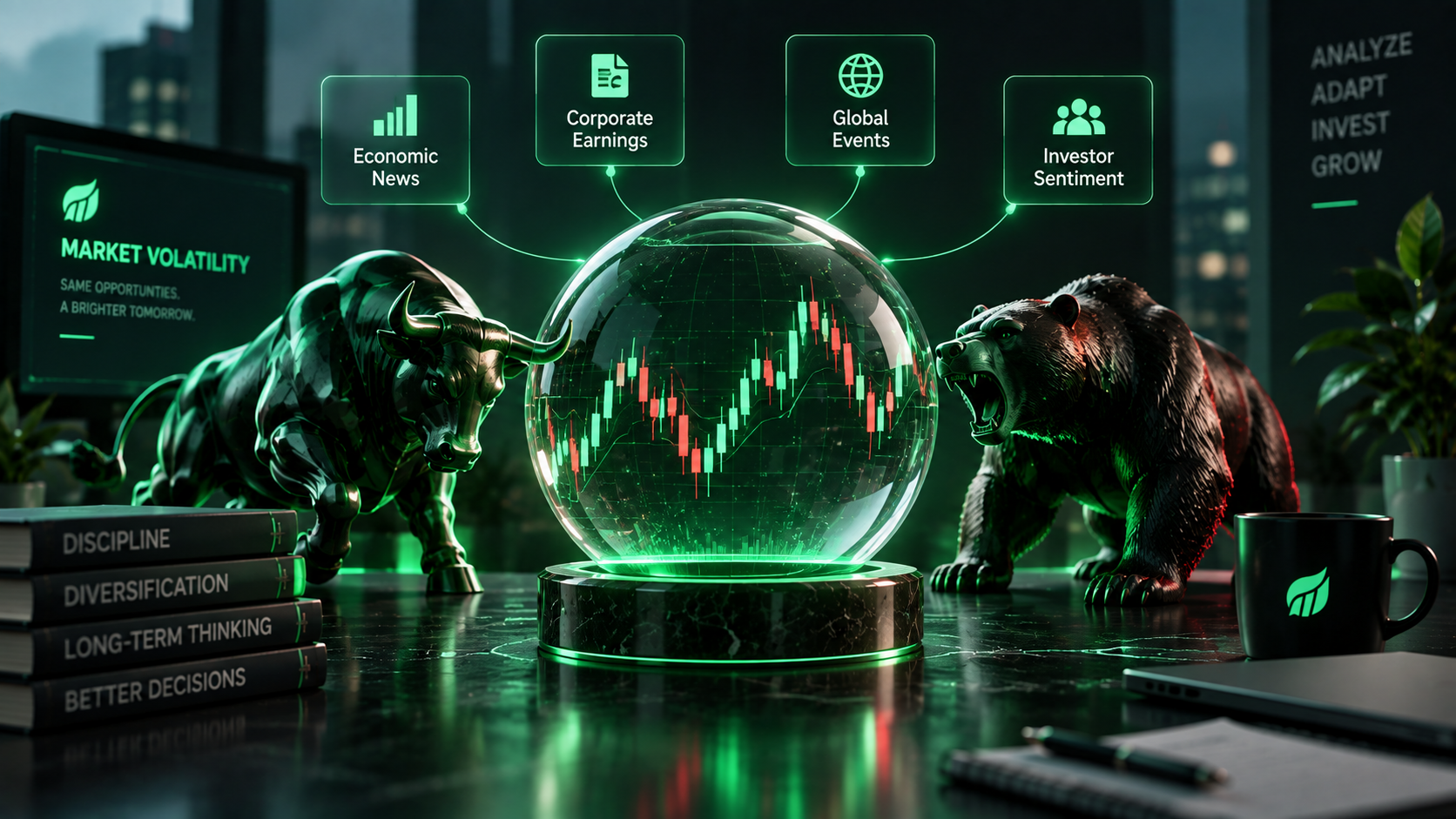
Understanding Market Volatility
Financial markets rarely move in a straight line. Prices rise, fall and fluctuate every day as investors react to economic news, company performance, global events and changing market sentiment. These constant price movements are known as market volatility and represent a natural part of investing.
For many new investors, volatility can appear intimidating. However, understanding why markets move and how volatility affects investments is an important step toward making informed financial decisions.
What Is Market Volatility?
Market volatility describes the rate at which the price of an investment changes over time. Higher volatility means prices move more rapidly, while lower volatility indicates more stable price movements.
Volatility is present across all financial markets, including stocks, commodities, cryptocurrencies, exchange-traded funds and other investment products.
Why Do Markets Become Volatile?
Financial markets respond to new information almost instantly. Economic reports, inflation data, interest rate announcements, corporate earnings and political developments can all influence investor expectations and cause prices to move.
Investor psychology also plays an important role. Optimism can drive prices higher, while uncertainty or fear may increase selling activity and lead to greater market fluctuations.
Is Volatility Good or Bad?
Volatility itself is neither positive nor negative. It simply reflects changing market conditions. While periods of high volatility may increase investment risk, they can also create opportunities for investors who have a clear strategy and understand market behavior.
Long-term investors often view temporary market fluctuations as a normal part of the investment process rather than a reason to abandon their financial goals.
Common Causes of Market Volatility
Economic News
Reports on inflation, employment, economic growth and interest rates frequently influence financial markets because they affect expectations about future economic performance.
Corporate Earnings
Public companies regularly publish financial results that may exceed or fall below investor expectations, often leading to significant price movements.
Global Events
International events, regulatory changes, geopolitical developments and natural disasters can all influence financial markets and increase short-term volatility.
Investor Sentiment
Markets are influenced not only by financial data but also by investor confidence. Changes in market sentiment can accelerate buying or selling activity even when underlying fundamentals remain relatively stable.
How Investors Can Respond to Volatility
Experienced investors generally avoid making decisions based solely on short-term market movements. Instead, they focus on long-term objectives, diversification and disciplined investment strategies.
Maintaining realistic expectations and avoiding emotional reactions during periods of uncertainty often contributes to better long-term investment outcomes.
The Importance of Diversification
Diversification helps reduce exposure to individual investments by spreading capital across multiple assets, industries or sectors. Although diversification cannot eliminate market risk entirely, it may reduce the impact of volatility on an overall portfolio.
Many long-term investment strategies incorporate diversification as one of their core principles.
How Artificial Intelligence Helps During Volatile Markets
Artificial intelligence can process enormous amounts of financial information during rapidly changing market conditions. Instead of manually reviewing countless news articles, economic reports and market charts, investors can use AI-powered analysis to receive organized insights more efficiently.
This allows investors to better understand changing conditions while maintaining a structured decision-making process.
How Yevandrium AI Supports Market Analysis
Platforms such as Yevandrium AI continuously analyze financial markets using artificial intelligence. By organizing market information into structured insights, the platform helps investors understand periods of increased volatility without manually processing large amounts of financial data.
Artificial intelligence does not eliminate market uncertainty, but it can significantly improve research efficiency and provide valuable analytical support.
Keeping a Long-Term Perspective
History has shown that financial markets naturally experience periods of both growth and decline. Investors who remain focused on long-term objectives rather than reacting to every short-term price movement often develop more consistent investment habits.
Patience, diversification and continuous learning remain important components of successful investing regardless of current market conditions.
The Future of Market Analysis
As artificial intelligence continues advancing, investors will gain access to increasingly sophisticated analytical tools capable of processing larger datasets and identifying market trends more efficiently than ever before.
Technology will continue supporting investors by improving research capabilities while allowing human judgment to remain at the center of every investment decision.
Conclusion
Market volatility is a normal characteristic of financial markets and should be expected by every investor. Understanding what causes volatility, maintaining a long-term perspective and using reliable research tools can help investors navigate changing market conditions with greater confidence.
Combined with disciplined investing and AI-powered market analysis, a thoughtful approach to volatility can become an important part of building a successful long-term investment strategy.